
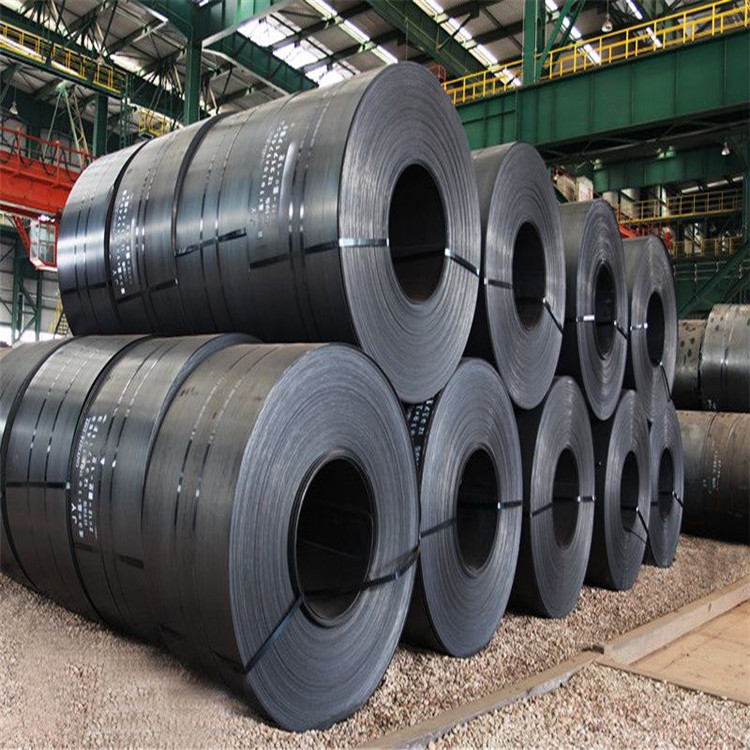
1. Definition and Production Process: Hot-rolled coils are made from slabs (mainly continuously cast slabs). The slabs are first heated uniformly to approximately 1200℃-1250℃ in a walking beam furnace. Then, high-pressure water jets are used to remove the iron oxide scale from the slab surface. The slab is then processed into strip steel via roughing and finishing mills. Finally, the hot steel strip is cooled to a set temperature using laminar flow cooling and coiled into coils by a coiler.
2. Performance Characteristics:
- Hot-rolled coils offer advantages such as high production efficiency and lower cost.
- High-temperature rolling eliminates casting defects and refines the grain size, resulting in good plasticity and toughness, making them easy to form.
- They have a wide size range, covering thicknesses from thin to medium-thick plates, with widths exceeding 2000mm. However, their surface is typically covered with a thin blue iron oxide film, making them slightly rough, and their dimensional accuracy and surface finish are not as good as cold-rolled coils.
3. Classification:
According to material and application, hot-rolled coils can be divided into ordinary carbon structural steel hot-rolled coils, such as Q235B and SS400, mainly used for structural components and welded steel pipes;
High-quality carbon structural steel hot-rolled coils, such as 08Al, 20, and 45#, commonly used in automotive parts and machinery manufacturing; and low-alloy high-strength steel hot-rolled coils, such as Q345B and Q355B, used for vehicle beams and bridge structures. According to subsequent processing methods, they can be divided into cold-rolled base materials and pickled sheets.
4. Application Areas:
Hot-rolled coils are truly "industrial grains," with a wide range of applications.
- They are the main raw materials for deep processing such as cold-rolled sheets (coils) and galvanized/aluminized zinc sheets.
- In structural manufacturing, they can be used for steel structures in factory buildings and bridge auxiliary structures in construction engineering;
- Truck bodies and automobile chassis in vehicle manufacturing; and engineering machinery frames in machinery manufacturing.
- They can also be used to manufacture containers and pressure equipment such as oil tanks and water tanks, as well as containers and internal structural components of household appliances.
Post time: Jan-07-2026